Food Now has been providing supplemental food assistance to families in the Desert Hot Springs area since 1959. This November, more than 800 men, women, and children have been lining up each week at the 66-year-old food pantry, an all-time-record that’s also up nearly 70 percent from last year at this time, according to Tom Tragesser, Food Now’s vice president and director of operations.
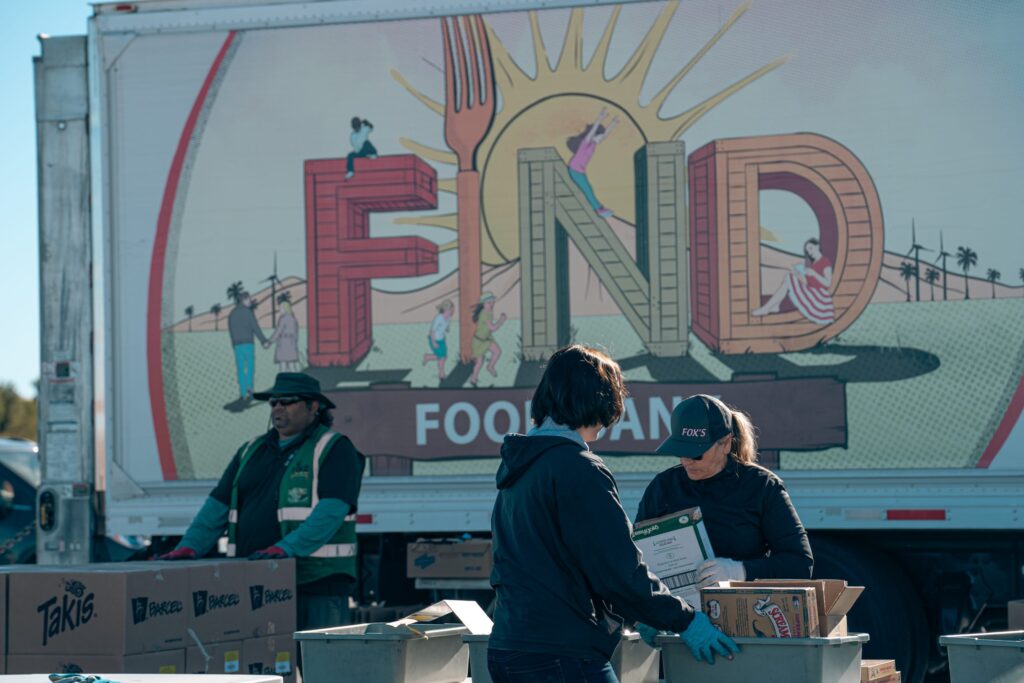
“The numbers of people who are suffering from food insecurity are growing,” Tragesser says.
A similar situation was unfolding at the east end of the valley, where the Mecca-based Galilee Center has been distributing 500 food boxes a week, double its weekly count from last year, according to Claudia Castorena, who co-founded the food bank with Gloria Gomez in 2010.
Food insecurity, defined as the inability to purchase enough food to adequately meet one’s basic needs, is increasing across the Coachella Valley along with the incidence of hunger, according to Debbie Espinosa, president and CEO of FIND Regional Food Bank in Indio.
Espinosa is keenly aware of food insecurity across the valley because FIND serves as the primary food supplier to over 120 food pantries and homeless shelters from Desert Hot Springs to North Shore. FIND is the primary supplier of free food for the Coachella Valley Rescue Mission, Martha’s Village & Kitchen, the Galilee Center, and well-known food pantries at The Center in Palm Springs, College of the Desert, St. Margaret’s Episcopal Church in Palm Desert, and Catholic Charities in the East Valley.
From its recently expanded warehouse facilities in Indio, FIND has distributed more than 20 million pounds of food in the past year. “This translates to approximately 16.5 million meals,” Espinosa says, noting that FIND also deployed 22 mobile pantries to “food deserts” in the region, which do not have a local food pantry, or areas with an intensive amount of food-insecure people.
FIND documented 168,241 client interactions valleywide in October, up 34.6 percent from a year earlier.
In the Coachella and Morongo valleys alone, more than 50,000 people rely on the federal Supplemental Nutrition Assistance Program (SNAP), called CalFresh in California, Espinosa says.
The numbers of individuals and families struggling to meet their basic food needs intensified across the Coachella Valley during the 43-day government shutdown, from Oct. 1 to Nov. 12, when the federal government suspended funding for SNAP/CalFresh. The modern iteration of America’s historic food stamp program provides qualifying recipients with EBT cards, which they can use to purchase fresh fruits and vegetables, meats, and poultry, as well as seeds and plants for growing their own food.
Food insecurity was on the rise across the Coachella Valley even before the government shutdown, however, and it’s likely to continue into next year and beyond as growing numbers of individuals and families struggle to make ends meet with paychecks that fail to keep up with the escalating costs of housing, insurance, utilities, groceries, and inflation.
According to the most recent data from HARC Inc., the Coachella Valley’s local data source for nonprofits, 29 percent of Coachella Valley adults have spent less money on food because they needed to prioritize other basic needs, such as healthcare, housing, transportation, or utilities. “This equates to more than 98,500 people cutting back on food purchases due to financial strain,” says HARC CEO Jenna LeComte-Hinely, Ph.D. “The pinch is even more difficult for families with children — 39 percent of households with children had to spend less money on food in order to afford these basic expenses.”
But although SNAP/CalFresh is extremely helpful, the program is designed to deliver only supplemental food assistance and does not provide recipients with enough support to cover the cost of all their food needs. Espinosa says many CalFresh recipients wind up going to food banks to gather the additional food they need.
Many CalFresh recipients exhausted their food benefits weeks before the government shutdown, Espinosa says, and had to rely on local food pantries. “We’re not only seeing more people, but existing clients who are coming more often,” she says.
Even as food insecurity has increased, the Trump administration has made significant cutbacks in federal funds for food banks as well as SNAP.
In spring, the Trump administration slashed $500 million in funding for the USDA’s Emergency Food Assistance Program, which purchases and delivers U.S.-produced meat, dairy products, eggs, and fresh produce to food banks across the country, including FIND Regional Food Bank in Indio. The $500 million cutback amounts to about a quarter of the funding that the USDA program received in 2024. “This cutback alone affects every food pantry and homeless shelter in the Coachella Valley because the majority of them depend on FIND for the majority of their food supply,” Espinosa says. “We all work together to address food insecurity with FIND serving as the regional hub for receiving donated and government food from across the country into our area, then deploying this food out to local food banks, food pantries, and homeless shelters.”
A ProPublica report in October noted that the cutbacks resulted in at least 94 million pounds of food lost across the country. The Trump administration’s One Big Beautiful Bill Act, which President Donald Trump signed into law on July 4, reduces SNAP funding by 20 percent, or $186 billion, over the next decade, while imposing additional work requirements and other restrictions on the people who can receive SNAP benefits.
CalFresh delivered more than $12.5 billion in food assistance to an average of 5.5 million food insecure Californians in 3.3 million households in the 2024–25 fiscal year, according to a report from the nonpartisan Legislative Analyst’s Office. As the federal government continues to scale back its support, FIND and other regional food banks must look to the state as well as private donors to make up for shortfalls.
Meanwhile, homeless shelters, churches, and nonprofit organizations are stepping up their efforts to address the burgeoning food insecurity in the Coachella Valley.
For example, Coachella Valley Rescue Mission in Indio is increasingly providing meals for food-insecure families in addition to homeless people who live at the shelter, according to Scott Wolf, the Rescue Mission’s development director.
“Not only are we serving well over 300,000 meals a year to the residents who stay with us in our programs and the people who stay in our emergency shelter,” Wolf says. “We also hand out about 125 to 150 food boxes to food-insecure families in our community each week.” He adds that the demand for food boxes has increased significantly in recent months.
Martha’s Village & Kitchen in Indio is providing food pantry services that distribute about 3,000 meals each month for individuals and families, says Rosa E. Verduzco-Ruiz, chief operating officer.
“Our pantry serves individuals and families who have a home and access to a kitchen,” Verduzco-Ruiz says. “Clients may access the pantry up to three times per month, and each visit provides three meals for three days for every household member listed.”
Martha’s Village also operates a hot meal program. “On average, this program services around 8,000 hot meals per month,” Verduzco-Ruiz says.
Meanwhile, the Catholic Diocese of San Bernardino has partnered with Catholic Charities of San Bernardino & Riverside Counties and the Knights of Columbus to gather and deliver food donations for Coachella Valley residents suffering from food insecurity, says Jesse Gonzalez, Catholic Charities’ chief operating officer.
Each box of food, called Matthew’s Harvest, contains four meals for a family of four, Gonzalez says, noting that enough food for 5,760 meals was delivered to four parish locations across the Coachella Valley in November: St. Elizabeth of Hungary Catholic Church in Desert Hot Springs, St. Theresa of the Child Jesus in Palm Springs, St. Louis Catholic Church in Cathedral City, and Mission San Juan Diego in North Shore.
Food-insecure families in Desert Hot Springs will also be able to enjoy Thanksgiving dinner, Tragesser says, citing donations of 500 turkeys from the Agua Caliente Band of Cahuilla Indians, 300 turkeys from the Morongo Band of Mission Indians, and shelf-stable trimmings from Xavier Preparatory High School in Palm Desert.
Numerous groups from across the Coachella Valley received turkeys from the Morongo tribe, including the Coachella Valley Rescue Mission, St. Elizabeth’s Food Pantry, and First Community Baptist Church in Desert Hot Springs.
The Morongo tribe also delivered 200 turkeys to the Palm Springs Unified School District to help students and their families enjoy a meaningful holiday meal together. According to a news release, the Morongo tribe gave away 15,000 turkeys to nonprofit groups, churches, and charities in the Coachella Valley and across Southern California as part of its 39th annual Thanksgiving outreach program.
“The roots of Morongo’s Thanksgiving outreach program stretch back decades to a time when our tribe sought to help others even as we struggled in face of adversity,” Morongo Tribal Chairman Charles Martin says in a statement. “This year, we continue to honor our Tribe’s legacy of giving to others by providing tens of thousands of holiday meals to those who are struggling across the region.”
Rotary Clubs have also been doing their part to address the food crisis. The Palm Desert Rotary Club’s Angels of Service program, which past club President Ricardo Loretta launched in 2020 during the pandemic, has also worked out special arrangements to purchase food at a discount from Albertsons, which it delivers every two weeks to several well-known food pantries, including Food Now, College of the Desert, California State University, San Bernardino’s Palm Desert Campus, St. Margaret’s Episcopal Church, and the Joslyn Center. These deliveries supplement what these pantries receive from FIND, and add a wider variety of food for clients, Espinosa says.
Loretta, who has also served on the board of the directors of the Galilee Center since 2012, says the food insecurity crisis is widespread in the valley and is affecting everyone from college students to senior citizens. For many local college students, he says, the only food they eat is what they can pick up from campus food pantries.
Even Indian Wells, which has long been one of the most affluent cities in the valley, has somewhere from 150 to 200 food-insecure residents, Loretta says, citing food pantry registrations.
Palm Desert Rotary Club’s Angels of Service has had to broaden its purchases to include pet food, which it donates to food banks because some seniors will sacrifice their own food to feed their pets, Loretta says: “They go without eating and feed their pets because they don’t have the money to buy both types of food.”
Why Are So Many People Hungry in the Coachella Valley?
Forty-two million people — or one in eight Americans — receive Supplemental Nutrition Assistance Program (SNAP) benefits, including more than 50,000 in the Coachella and Morongo valleys.
More than one in five Coachella Valley adults worry whether their food will run out before they have money to buy more, according to Jenna LeComte-Hinely, Ph.D., CEO of HARC Inc., the Coachella Valley’s local data source for nonprofits.
Food insecurity is even worse for families with children; 46 percent of Coachella Valley children live in households with food insecurity concern, says LeComte-Hinely, citing a 2022 HARC survey.
This begs the question: Why are so many people suffering from food insecurity in the Coachella Valley and across the country?
The reasons include wages that haven’t kept pace with inflation, and the rising cost of housing, utilities, and insurance, according to experts in food insecurity.
“For the majority of Americans, inflation has outpaced wage growth over the past four decades, thereby reducing a household’s overall purchasing power, meaning they can’t afford the same basket of goods they used to be able to afford decades ago,” says Kurt Schwabe, Ph.D., a professor of environmental economics and policy at the University of California, Riverside.
Schwabe, who also serves as chairman of Feeding America of Riverside and San Bernardino Counties, which is part of the Feeding America national food bank network, says many Americans work in jobs with low pay or limited or unstable hours.
This scenario is particularly common in the Coachella Valley, where many people work in seasonal, relatively low-paying jobs in tourism and agriculture that do not include health insurance or paid sick leave. “This means if they get sick or pregnant, or if they have to take care of someone who becomes sick or pregnant, they can lose their job or have to pay high prices to get these services,” Schwabe says.
The rising cost of housing is also causing growing numbers of people in the Coachella Valley to experience food insecurity.
“Food banks are one of the best defense mechanisms against homelessness,” says Debbie Espinosa, president and CEO of FIND Regional Food Bank in Indio. “People will go without food to pay the rent and utilities because they don’t want to be homeless. Providing them food helps them continue to pay for their housing.”
To understand the magnitude of food insecurity in the Coachella Valley, consider the Palm Springs Unified School District. “Ninety-five percent of our students are socioeconomically disadvantaged and would qualify for free or reduced meals,” says Joan L. Boiko, the district’s coordinator of communications and community outreach.
As a Community Eligible Provision (CEP) district, PSUSD provides free breakfast, lunch, and dinner for all students. “We qualified (and continue to qualify) for this provision for the last several years,” Boiko says, adding that students who want dinner at school can receive it about 30 minutes before the end of the school day.
Approximately 80 percent of students in the Desert Sands Unified School District have critical needs and qualify for free or reduced price meals. “All students in our district eat for free, regardless of family income, ensuring that no child goes hungry,” Desert Sands says in a written statement. “While we haven’t seen indications of the food crisis getting worse, our meal participation has remained steady and stable over the last month, reinforcing our essential role in addressing community food security through education.”
The Coachella Valley’s latest food insecurity statistics will be included in HARC’s 2025 Community Health Survey, to be released in late February.
How You Can Help
Food banks and pantries can use monetary contributions as well as donations of nonperishable foods, and many also need volunteers to help pack and deliver food.
Vania Otiura, a junior at Palm Desert High School, has been volunteering as a Youth Advisory Commission Ambassador for FIND Regional Food Bank in Indio for the past three years.
“We give FIND ideas on how we can apply the fight against hunger at the youth level,” says Otiura, who serves FIND with ambassadors from other valley high schools.
The students have been battling stigma associated with food insecurity. Most people, including children, are embarrassed to talk about food insecurity. “I would say at least 60 percent of our students are in line every day for a school-provided breakfast or lunch,” Otiura says. “That tells us these meals are basic resources that our student campus needs.”
Otiura and her fellow ambassadors came up with the idea last year of including discussions and information about food insecurity on Palm Desert High School’s weekly Aztec Newscast, which is shared with students online through YouTube.
“One of the main ideas we share is that the resource of FIND Regional Food Bank is out there for everyone,” Otiura says, adding that it’s helpful to educate students about the importance of budgeting and knowing how to find food pantry resources when they go to college.
Debbie Espinosa, FIND’s president and CEO, says she developed the youth ambassador program to educate students about the realities of systemic hunger and give them opportunities to develop their skills as community leaders. Ambassadors are selected for their willingness to go above and beyond to speak out and serve their community.
The following organizations offer opportunities to volunteer:
- Catholic Charities
- Coachella Valley Rescue Mission
- FIND Regional Food Bank
- Food Now
- Martha’s Village & Kitchen
Teresa Rocha, who works in the Life, Dignity and Justice Department of the Catholic Diocese of San Bernardino, also recommends that people contact their local churches to inquire about volunteer opportunities to address the food insecurity crisis.
Where to Obtain Food Donations
FIND Regional Food Bank in Indio has an online search tool that can help you identify the nearest food pantry. Type in your address and the website will pinpoint the location of the closest food pantry. More than 120 food pantries are available across the Coachella Valley.
Senior citizens can also apply for food assistance through the Mizell Center in Palm Springs, which is the only Meals on Wheels provider in the Coachella Valley. Mizell delivers meals to seniors from Whitewater to Thermal through the Meals on the Wheels program. “We are contracted through the Riverside County Office on Aging as part of their senior nutrition program,” says Rob Wheeler, Mizell’s executive director, adding that he has seen an increase in phone calls from seniors seeking food assistance.
Mizell also provides group lunches at the center as part of its nutritional outreach services in addition to delivering meals to four other senior centers in the valley. Seniors can sign up through Mizell to participate in the “congregate meals” program. “There is a suggested donation of $3 for lunch, but the donation is not mandatory for those of limited means,” Wheeler says.
Many seniors enjoy coming to Mizell to have lunch with other seniors. “The social connection part is huge,” Wheeler said. “We have people who live alone. They live on fixed income. They don’t have family or friends in the valley and the only social connection they have is at Mizell.”